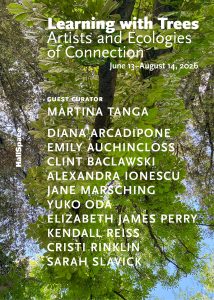
Tree Boston is excited to partner with Martina Tanga, Independent Curator, to bring the exhibit Learning with Trees: Artists and Ecologies of Connection to Dorchester.
The exhibition will span two locations, Boston City Hall and HallSpace in Dorchester. Tree Boston is excited to engage our local community with this exhibition, both at the June 13 Opening Reception (RSVP here) and at other events during the summer.
Martina’s Curatorial Statement
Learning with Trees: Artists and Ecologies of Connection
“Between every two pine trees, there is a door leading to a new way of life.”
–John Muir
Trees are the lungs of our planet—living beings fundamental to human well-being, Earth’s stability, and essential to countering climate change. Artists have long recognized the power of trees, weaving them into cultural, religious, and spiritual narratives across millennia. At this pivotal moment for planetary sustainability, artists illuminate what trees can teach us about survival, connection, and time.
This exhibition, organized in collaboration with Tree Boston, brings together local artists who center trees as collaborators and teachers in their practice. The exhibition directly advances Tree Boston’s mission of building community around tree planting and preservation, education, and advocacy in Boston’s environmentally marginalized neighborhoods, demonstrating how art transforms our relationship with urban nature.
Through painting, sculpture, textiles, installations, and participatory works, these artists reveal how trees thrive in cooperative forest communities, communicate through underground mycorrhizal networks, and experience time across centuries rather than years, ultimately bringing us, humans, closer to trees. The work carries particular urgency here: Boston is situated within the Boreal Forest, the Northern Hemisphere’s vast carbon sink, which has lost nearly half of its expanse since the Industrial Revolution.
These artists forge new pathways for Bostonians to recognize themselves within a larger living network. They reveal trees as teachers, timekeepers, and community builders—showing us how our survival is intertwined with theirs, our roots entangled beneath the city streets, our futures growing toward the same light.