Hello from Spain, where I’ve been on a 10-week sabbatical. My time has been spent relaxing, exploring, and eating great food. During these travels, I’ve of course taken time to note and enjoy the trees, whether they be out in the wild or in the center of bustling cities.
As I was planning this trip, I had imagined that during my travels I’d have a big “ah-hah moment” about urban trees, about how Spaniards do things differently, and how I could bring home some lessons learned. But I’ve come up short. Sure, they do things differently here, but there’s more to be said about similarities than difference.
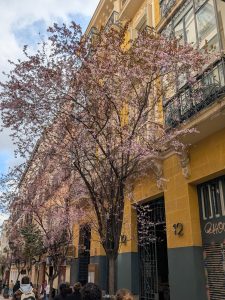
Let’s start with the basics: Just like in Boston, the trees I have seen come in all shapes and sizes, from pine trees to olive trees, and palms to orange trees. I’ve seen boulevard-arching sycamores and sidestreets lined with blossoming cherry trees. Some streets are covered with trees, others are bare. Sure, I noted a different palate of species, a more aggressive pruning style, and different planting methods. What struck me, though, was the deep love of trees in cities. No matter the small town or big cities I’ve visited, I’ve seen a universal commitment to trees, a deep appreciation and pride in trees. But, more than all that – I’ve seen a city take and make its identity through its trees.
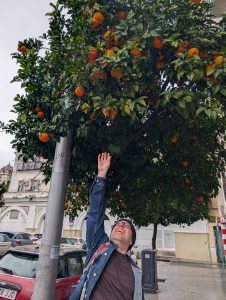 I’ve spent most of my time in Seville, where streets are lined with orange trees – over 14,000 of them! This particular species, in fact, is called the Seville Orange. It’s very bitter fruit, free for the taking, and too bitter to be eaten. Instead, the fruit is harvested annually and used to produce the highly coveted orange marmalade. And the flowers, blossoming in March and April, are used for aromatherapy and perfume.
In the capital, Madrid, there’s pride among Madrilenians for the city emblem: a bear on his hind-legs standing up on a strawberry tree (Arbutus unedo). No, it’s not a tree that grows strawberries, but rather a small evergreen tree that produces small fruits that resemble strawberries. The origin of the emblem is unclear; it likely had something to do with who had control of forests and its lumber around Madrid. The symbol can be found everywhere, including on utility hole covers and at a large public park in the center of the city where a huge bronze statue stands. It can also be found on the badge of the local professional soccer team, Atlético Madrid.
And finally, during a visit to Grenada, I noted the main thoroughfares lined with towering Ginkgo trees whose bright yellow leaves must highlight the boulevards in the fall. A stunning site, for sure, that I’m sure was intentionally created to create a sense of wonder and beauty.
Instead of bringing new ideas to Boston – let’s plant orange trees! I’ve come to realize the universal appreciation and love that trees provide. Trees are treasured, valued, and cared for because they cool, provide beauty, and ensure well-being. But they also create a sense of belonging by providing cities with an identity and pride for locals and visitors alike. From statues to jams, jerseys to tourist shops, trees define place – no matter the city.