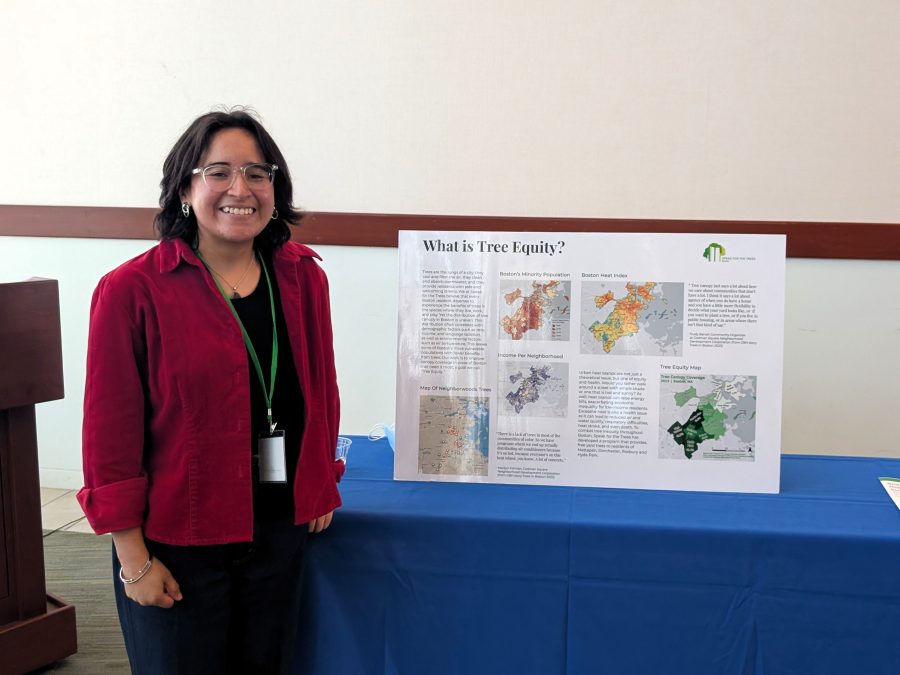
Lilian Bonilla-Reyes, Urban Forestry Fellow for Speak for the Trees (SFTT), gave a poster presentation on growing Tree Equity through our NeighborWoods program at the Bridging Communities with Hope: Environmental Justice Conference hosted by UMass Boston last month. Through the poster, Lilian explained the concept of Tree Equity and demonstrated how the NeighborWoods program helps to combat the urban heat island effect in neighborhoods with low tree canopy coverage.
Trees are the lungs of a city; they cool and filter the air, they clean and absorb stormwater, and they provide residents with safe and welcoming streets. Yet the distribution of tree canopy in Boston is uneven. This distribution often correlates with demographic factors such as race, income, and language isolation, as well as environmental factors such as air temperature. This leaves some of Boston’s more vulnerable populations with fewer benefits from trees. Using maps created by geospatial analyst Chad Fisher, Lilian explained the correlation between minority population, annual income, and tree canopy coverage.
The neighborhoods with high minority populations and lower incomes have lower tree canopy coverage and higher heat indexes. The poster prompted several conversations about the importance of nature spaces and how trees act as public utilities. See the maps here.
Through Neighborwoods, SFTT gifts and plants trees for free to residents of Mattapan, Roxbury, Dorchester, and Hyde Park. The program has been popular since it launched and we currently have a waiting list. More information about NeighborWoods can be found here.